|
Get all the latest model railroad news and views from the world of model
railroading.
Stay up to date in the most enthralling (ok I'm biased) hobby in the
world...model
railroading!
Explained: Prototype Railroads vs Model
Railroads
Beginners to the wonderful world of model railways often get confused with the
term
prototype trains. Generally, model railroad enthusiasts will refer to the real
(full size)
trains as prototypes. As the name implies, every railway track system is a unique,
one of a kind system.
This explains why the phrase 'prototype train' is a good description for full
size train. If, as a model railroading enthusiast, your aim is to create your own
"real" system, then it is easiest to refer to full size trains as being
prototypes.
Model Railroad Train Scales And Track
Gauge
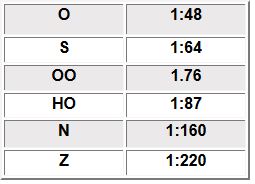
| The terms scale and gauge are two of the most confused
terms in the model railroad hobby. The SCALE proportion is
expressed as a fraction of a real life-sized railroad. As an
example, HO scale model train set is 1/87 the size of real
life-sized railroads. For model trains, track GAUGE is the width
between the inside running edge of the rails. For toy trains, track
gauge is the measurement from the center of the two outside
rails. |
 |
Analog Model Railroads - How They
Work
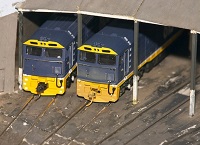 |
An Analog model railroad is simply a conventional model railroad
with conventional
analogue controls [DC or AC] to provide a power feed to a piece of
track. Any
locomotive that is on that piece of track will respond by moving
forwards or backwards.
|
The speed and direction of a model train is controlled by varying the voltage
and
polarity on the rails. The higher the voltage , the faster the locomotive moves,
the
lower the voltage, the slower the locomotive moves.
DCC Model Railroads - A Quick
Definition
DCC stands for Digital Command Control. It is a system that allows model
railroads to independently operate multiple locomotives, functions (speed, sound,
lighting, direction, movement) and accessories rather than control of sections of
railway track.This is achieved by locating a decoder in the locomotive that listens
to information in the track.
Laying Loose Ballast On Model Railroad
Layouts
When laying 'loose' track ballast, be very careful while distributing it around
point blades. Also, when laying 'loose' track ballast never run the trains until
the glue has fully dried and the track has been vacuum cleaned to ensure no loose
track ballast remains.
A Common Mistake To Avoid When Making
Scenery
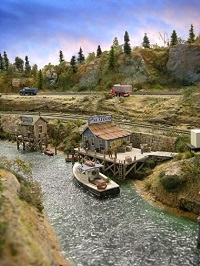 |
When making scenery for a model railway layout there is a
temptation to make trees too small. This probably because many
people live in housing developments that were built less than 40
years ago. In real life mature trees can be huge with some trees
being 80-100 feet or more in height.
If you are modeling conifers or other very large trees here's
what to do. Take your longest passenger car, turn it up on end, and
make the trees taller, up to half again as tall.
When positioning your trees on your model railroad, keep in mind
the loading gauge of your widest and longest rolling cars. Check to
see if the trees will be too close to the tracks BEFORE you glue
them into place.
|
Famous Railways & Railroad
Journeys
- 20,000 Commuters At Largest Train Station
- The world's largest station by number of platforms is Grand Central
- Terminal, Park Avenue and 42nd Street, New York City, USA.
- The station has 44 platforms situated on two underground levels with 41
tracks on the upper level and 26 on the lower level. Around 200,000 commuters
arrive and depart on approximately 550 trains every day.
- Grand Central was built over a 10 year period from 1903–13 and covers 19 ha
(48 acres).
London Underground - Interesting Railroad
Facts
Some interesting facts about the London Underground (affectionately known as
"The Tube"):
- Maximum depths below ground level - Northern Line, Holly Bush Hill,
Hampstead
67.4m (221ft)
- Deepest station - Hampstead 58.5m (192ft) below ground level
- Longest continuous tunnel - Northern Line, East Finchley to Morden (via
Bank)
27.8km (17.4 miles)
Australia Has Longest Straight
Railroad
- The Australian National Railways Trans-Australian line over the Nullarbor
Plain, is 478km. (297 miles) dead straight, from between Nurina and Loongana,
Western Australia, to between Ooldea and Watson, South Australia.
- As the name implies, the Indian Pacific Train travels from the Indian Ocean
all the way to the Pacific Ocean. This famous ocean to ocean train trip across
Australia is one of the world’s longest and greatest railroad journeys.
- This railroad journey from Sydney (on the East Coast) to Perth (on the West
Coast) covers 4352kms. The Indian Pacific Train travels from the spectacular
Blue Mountains to the treeless plains of The Nullarbor, where the train travels
the world’s longest straight stretch of railroad track (478 kilometres).
- Passengers experience three nights aboard the train as well as scheduled
stops at Broken Hill, Adelaide and gold rich Kalgoorlie. A remote outpost on
the Nullarbor Plain called Cook, population 2, presents a further opportunity
to stretch your legs.
- The Indian Pacific passenger train first ran in February 1970 from Sydney
Central to East Perth linked New South Wales, Victoria, South Australia and
Western Australia but by-passed Adelaide, the capital of South Australia. The
Adelaide rail terminal (with standard gauge connection) was opened in May
1984.
A3 Class 'Flying Scotsman'
Flying Scotsman is arguably the best-known steam locomotive in the world. Model
Train manufacturer Hornby produce replica models of 'Flying Scotsman' for model
railroading enthusiasts to add to their model railroad layouts.
- The A1 4-6-2 is presented in LNER livery with four teak coaches to
represent the period of non-stop running between London and Edinburugh over the
summer seasons of the 1930s.
- Hornby even have a complete 'Flying Scotsman' model railroad set containing
everything needed to just set up and run including: a transformer, controller
and track.
World's Longest RailwayJourney
The longest railway journey in the world without changing trains is 6,346 miles
(10,214km.), from Moscow, Russia, to Pyongyang, North Korea. The train trip takes
almost eight days with only one train a week taking this route.
Impressive Model Railroads
There are hundreds impressive model railroad layouts to be found all around the
world including countries like: Germany, New Zealand, Turkey, South Africa,
Australia, UK, Canada and USA to name but a few. Here are a couple of model
railroad layouts in the USA that are well worth a visit:
10,000 Square Foot Of Model Railroad
Track
The Golden State Model Railroad Museum in California has 10,000 square feet of
O
scale, HO scale and N scale model railroading. Inside the Golden State Model
Railroad Museum, you will find three large model railroads, constructed and
operated by the East Bay Model Engineers Society (EBMES). When visiting California
the Golden State Model Railroad Museum is well worth seeing. The museum is located
in Point Richmond, California (just north of San Francisco, at the north end of the
East Bay).
Indiana Model Railroad Layout Stretches 7
Miles
The Greater Midcontinent Railroad Company was founded in 1991. The HO scale
model railroad layout occupies approximately 20 by 30 feet of the basement of the
Garrett Historical Society Museum. The model railroad layout has about 7 scale
miles of track, which typically takes 20 minutes for trains to complete a circuit.
Prototypical operations are duplicated with the aid of a computerized system which
controls the model railroad layout.
|


|
